Present year
269
Three empires, one year.
By 269 the Roman world was split among a Gallic empire in the west, Palmyra in the east, and a central emperor fighting Goths. In China the Western Jin was already in place. The aperture finds politics, not instruments.
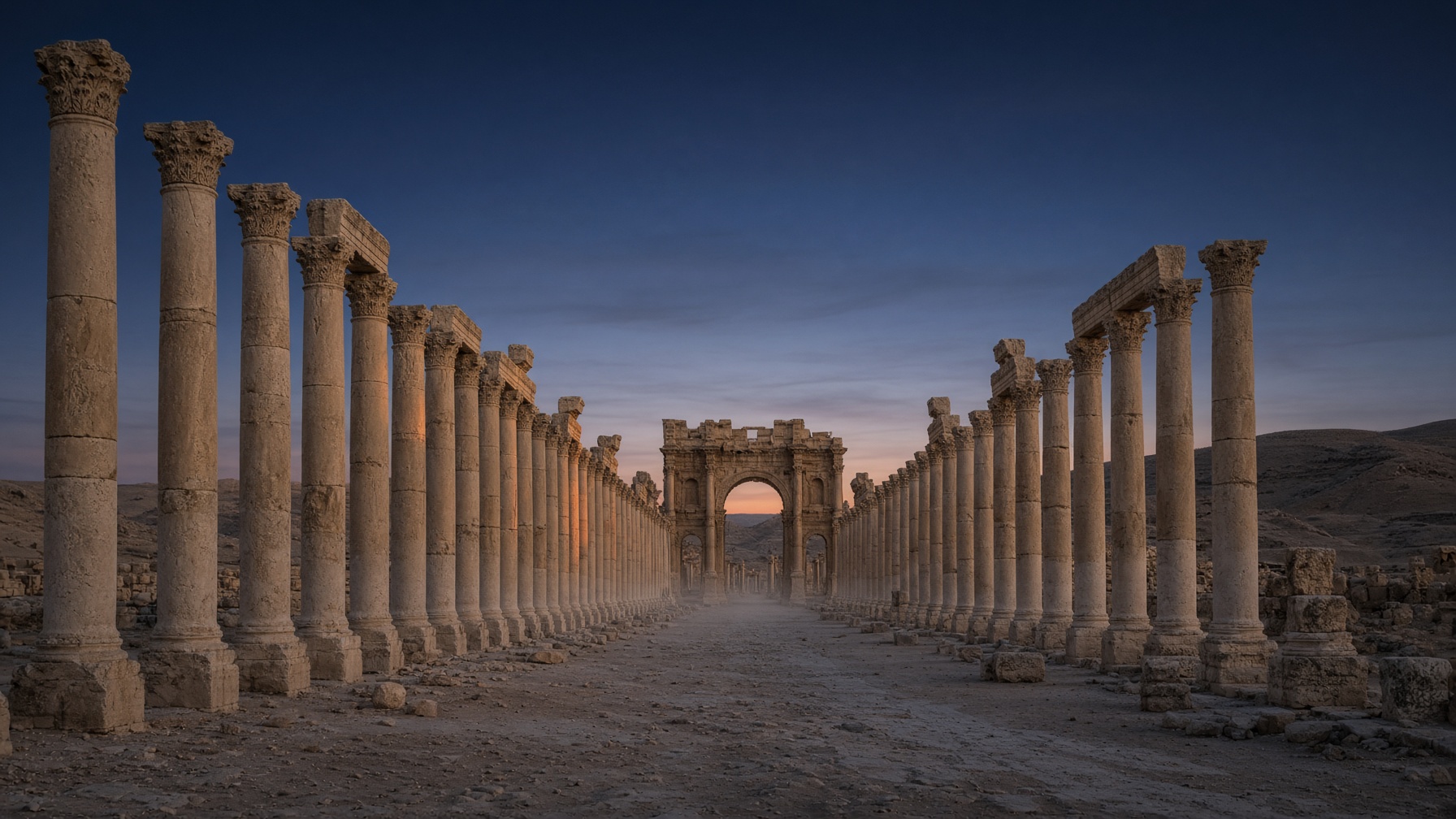
Later composition of the Great Colonnade. The stones remain. 269 is not this light. Palmyra acting as an empire while Rome was busy elsewhere.Editorial plate for this house. Not a visitor photograph, and not a picture of the year.
The hinge
Palmyra acting as an empire while Rome was busy elsewhere.
By 269 the Roman world was already split: a Gallic empire in the west, Palmyra in the east, a central emperor fighting Goths. The aperture finds politics, not instruments. Campaign dates around this year are one year uncertain. 268 may hold Naissus.
Same year. No arrow.
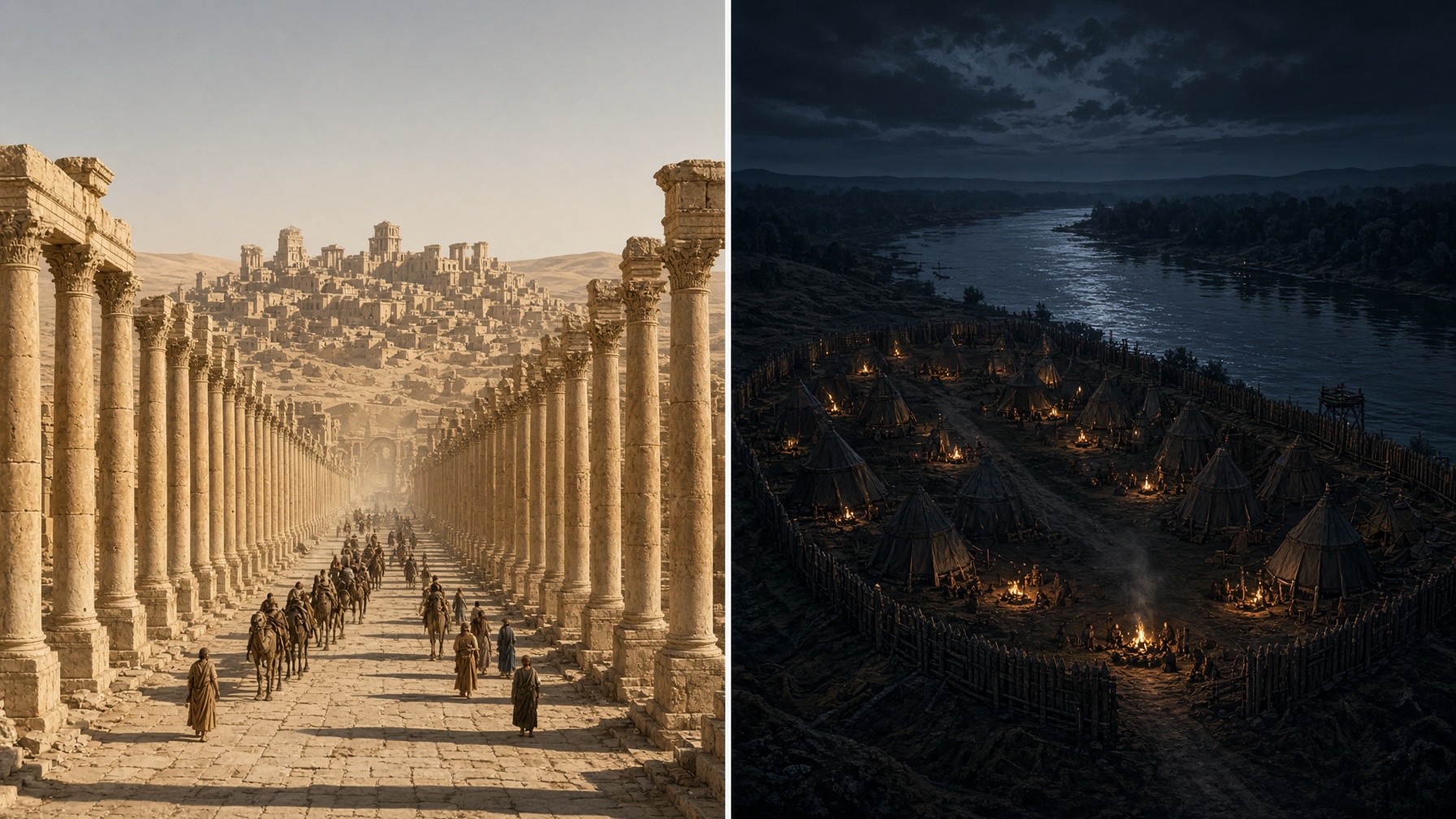
Palmyra in the breach
Zenobia, ruling from Palmyra for her son Vaballathus, extended control toward Egypt around this year. Claudius Gothicus campaigned against Gothic invasions. Dating of the Battle of Naissus is contested between 268 and 269.
Before
The crisis of the third century was already two decades old. Postumus had created the Gallic empire in 260.
Why
The third-century Roman state could not hold all frontiers at once. Local powers filled the vacuum.
Who
Zenobia of Palmyra; the emperor Claudius II; Gothic groups in the Balkans; Roman armies.
Zenobia · Claudius II Gothicus
What
Eastern Palmyrene expansion and western/central Roman crisis unfolded in the same broad season.
How
Military campaign and political assumption of titles.
The hinge
The hinge is Palmyra acting as an empire while Rome was busy elsewhere.
Where, and when
Palmyra in the Syrian desert, the Nile, and the Balkan provinces. Around 269. Several campaign dates are one year uncertain.
c. 269 CE · Palmyra, Egypt, the Balkans
What they knew
Participants knew they were fighting for grain, legitimacy, and survival. They did not speak of a 'crisis of the third century.'
What they could not know
Aurelian would soon reconquer Palmyra (272) and reunify the empire.
Source object
Later Roman historians and Palmyrene inscriptions
No single 269 chronicle. The Historia Augusta is unreliable. Inscriptions and coins are stronger.
The object survives.
First record
Coins, inscriptions, and much later narrative epitomes.
After
Aurelian restored central control. Palmyra was sacked.
Later retelling
Zenobia is often recast as a lone heroine. She ruled a court, an army, and a tax base.
Limit
Campaign-year uncertainty is honest. 268 may hold Naissus.
What it does not prove
Does not bind 269 to magnetism, maps, or light.
Why it entered
Included as political history that survives the threshold. Not as a rhyme with 1269.
How we know
- 1. Reference accounts of Zenobia and the Palmyrene empire, c. 269, with campaign-year uncertainty.
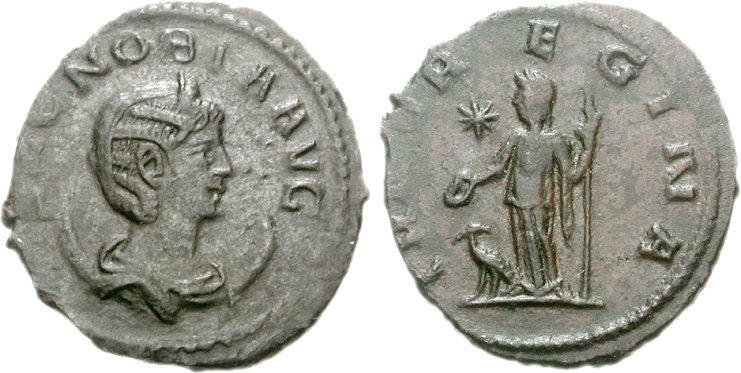
- 2. Antoninianus of Zenobia as Augusta. Antioch mint, March–May 272. RIC V.2. Classical Numismatic Group. Photograph on Wikimedia Commons. The strike is later than 269. See the record
Method
independent firsthardcontested
The aperture
A present year for political history. A quiet year for the later science and navigation cluster.
Regions checked
- Europe
- Middle East and North Africa
- East Asia (Western Jin)
- Africa
- the Americas
Included / excluded
- Included: Palmyra and the fractured Roman state
- Excluded: Battle of Naissus as a locked 269 event. Specialist dating often prefers 268. Treating it as certain 269 would be a miss.
68 | 69 | 70
Same century. Same research threshold. Matched frames. Neither pane brighter except that the middle year is the selected aperture.
268
Neighbor
Death of Gallienus. Accession of Claudius II. Possible year of Naissus. Neighbor is not quieter.
269
Aperture
A present year for political history. A quiet year for the later science and navigation cluster.
270
Neighbor
Death of Claudius II. Aurelian accedes. Palmyra still powerful.