Anchor year
1869
A gap can be a prediction.
In 1869 Dmitri Mendeleev’s classification of the elements was presented to the Russian Chemical Society. In London, the first issue of Nature appeared on 4 November. On 17 November the Suez Canal opened. None of these acts caused the others. Each is independently first. Together they make 1869 one of the densest years under this aperture, and a mirror for the project’s own method: a pattern that dares to leave blanks.
Can a pattern tell you something is missing?
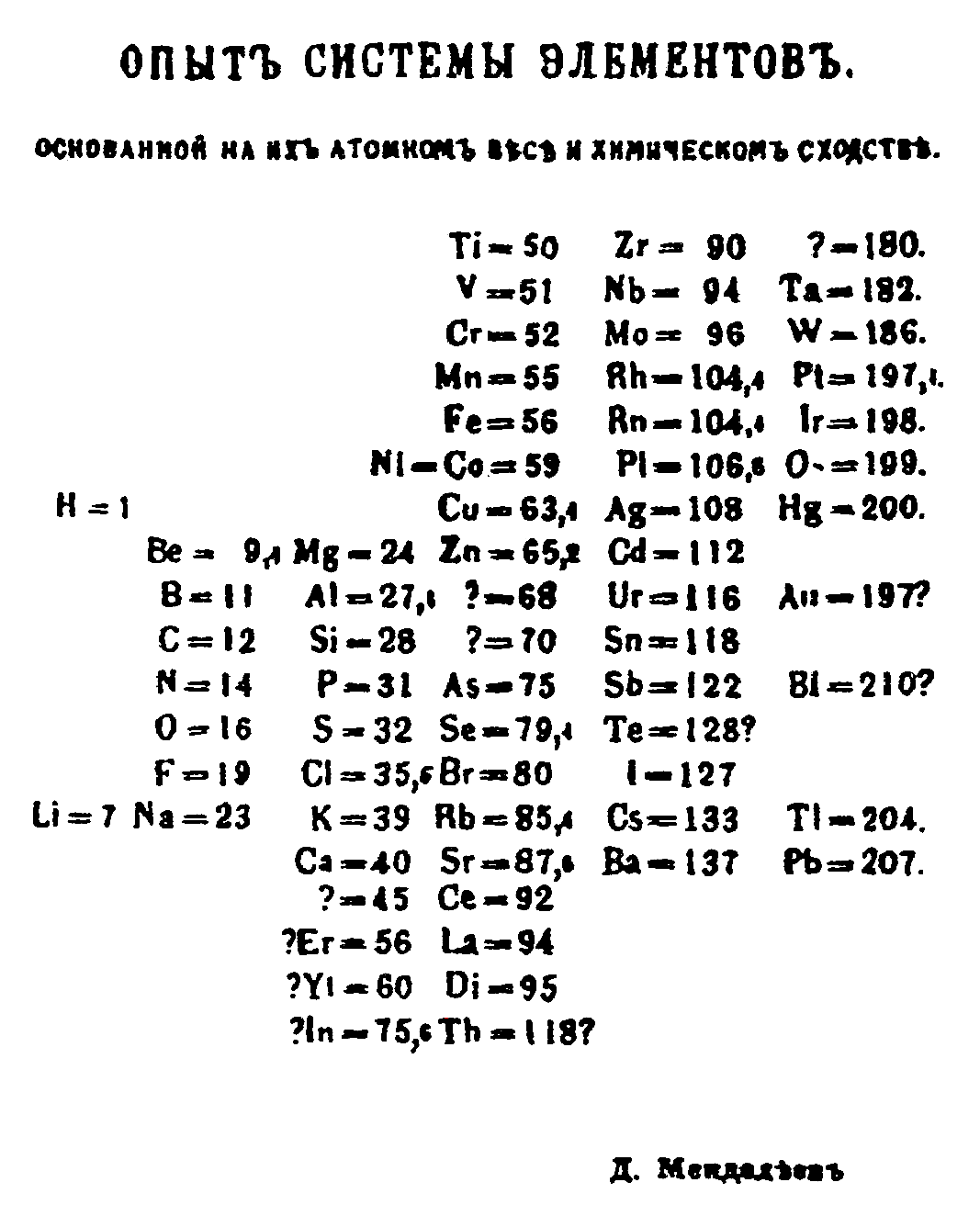
Order, and gap
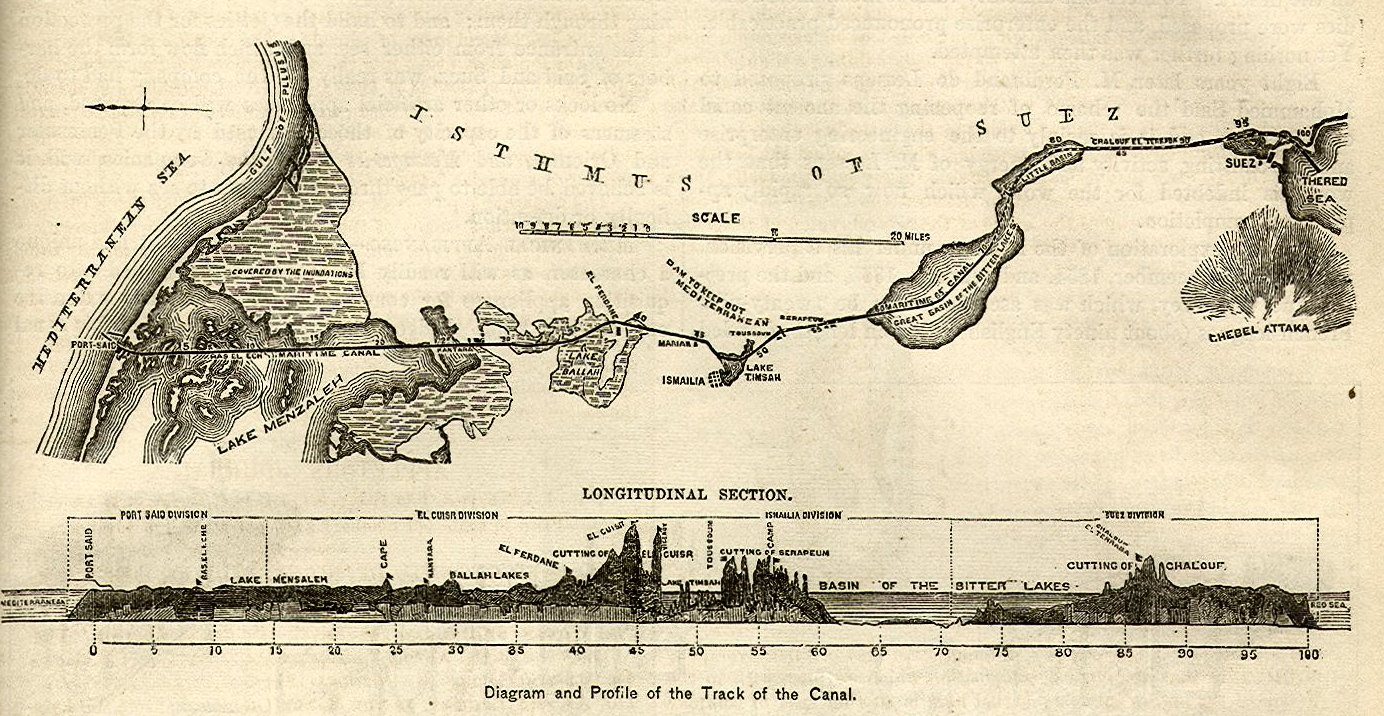
A cut between seas
ORDER
A table with blanks
Mendeleev arranged the then-known elements by atomic weight and recurring properties, left gaps, and implied that unknown elements should fill them. He did not speak that day. Menshutkin read the communication. About sixty-three elements were then recognized, depending on how one counts. Later successes (gallium, scandium, germanium) were real. Later retellings sometimes make the table a dream and the predictions flawless. Neither is accurate.
Before
Döbereiner’s triads, de Chancourtois’s telluric screw, Newlands’s octaves, and Meyer’s work. Mendeleev did not step into a void.
Why
Chemistry needed a teaching order and a way to see which atomic weights and which missing substances were the problem. The table was a tool before it was a monument.
Who
Mendeleev, professor in St. Petersburg, then 35, writing a textbook and looking for an order to teach. Menshutkin, colleague, who presented the paper because Mendeleev had left for a cheese-factory inspection. Other chemists, including Lothar Meyer, were working on related classifications.
Dmitri Ivanovich Mendeleev · Nikolai Menshutkin · the Russian Chemical Society
What
A table and a set of statements: properties are a periodic function of atomic weight; some weights are wrong; some places are empty and should be filled by elements with describable properties.
How
Cards, weights, chemical families, and a willingness to treat a blank as information rather than as failure.
The hinge
The hinge is not 'he changed science.' It is the act of leaving structured blanks and saying what should be there.
Where, and when
A meeting of the Russian Chemical Society in St. Petersburg. Ten communications that evening. This one was short, and discussion was postponed because the author was absent. Manuscript finished at the start of March 1869 (Julian). Presentation 6 March Julian, 18 March Gregorian. English sources that say only 'March 6' without the calendar are incomplete.
6 March 1869, Julian (18 March Gregorian), presented in Mendeleev’s absence · St. Petersburg
What they knew
He knew dozens of elements and their habits. He knew some weights were disputed. He did not know the noble gases, atomic number, or electron shells.
What they could not know
That atomic number, not weight, would be the deeper key (Moseley, 1913). That some of his specific predictions would fail or be revised. That a later culture would make him the lonely prophet of chemistry.
Source object
The 1869 table and the paper 'On the relation of the properties to the atomic weights of the elements'
Printed in the Journal of the Russian Chemical Society. Facsimiles of early tables survive.
The object survives.
First record
The 1869 communication and journal printing. A privately circulated sheet preceded the meeting.
After
Gallium (1875), scandium (1879), germanium (1886) made the gaps famous. Other predictions aged less well. The periodic system became chemistry’s house.
Later retelling
The dream-story, the perfect prophet, the lone genius. Meyer’s parallel work and the missed meeting are usually cut. This page puts them back.
Limit
Successful blanks in chemistry do not validate numerical apertures in history. Analogy is not proof. This project will not say: Mendeleev shows that 69 predicts. He shows that a pattern, in a defined domain, can be tested by what it misses.
What it does not prove
Does not prove historical numerology, and does not make every blank in this app a predicted element.
Why it entered
It entered the test as the year’s deepest methodological object: a pattern that keeps its failures visible.
Question
Can a pattern tell you something is missing?
How we know
- 1. Mendeleev, D. I. 'Sootnoshenie svoistv s atomnym vesom elementov.' Zhurnal Russkogo khimicheskogo obshchestva 1 (1869). Presented 6 March 1869 Julian by N. A. Menshutkin.
- 2. 'Mendeleev: On a Path to the Law.' Science First Hand. Reconstructs the missed meeting and the cheese-factory journey. See the record
Method
independent firsthard
VOICE
A weekly for science
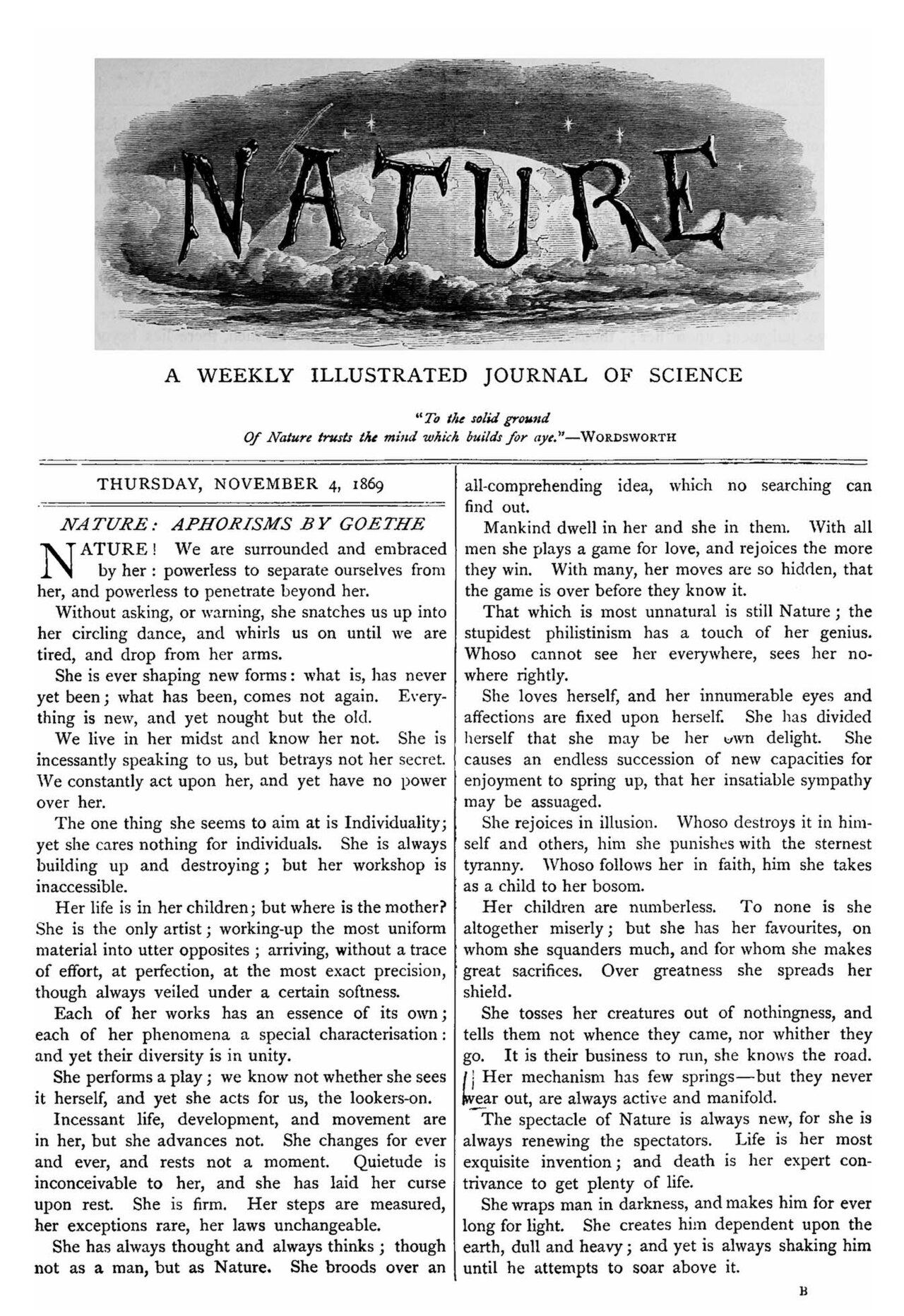
The first issue of Nature appeared on 4 November 1869, edited by Norman Lockyer and published by Macmillan. It was meant to put scientific work before a wider educated public and to give practitioners a common weekly. It did not invent science. It changed how science spoke to itself and to others.
Before
Philosophical Transactions, specialized society journals, newspapers. No Nature.
Why
Scientific results were scattered across society transactions and languages. Lockyer wanted speed, breadth, and argument.
Who
Lockyer, an astronomer and editor; Macmillan, the publisher; the first contributors.
Norman Lockyer · Alexander Macmillan
What
Issue 1 of a journal that still exists. A format: notes, articles, a public voice for a professionalizing science.
How
A commercial weekly, not a state academy organ.
The hinge
The hinge is a first number on a November Thursday.
Where, and when
London publishing, with a British and imperial readership. 4 November 1869.
4 November 1869 · London
What they knew
They knew they were making a magazine. They did not know it would become a prestige bottleneck.
What they could not know
Impact factors, later Nature’s gatekeeping power, or the 21st-century brand.
Source object
Nature, volume 1, number 1
A surviving periodical issue.
The object survives.
First record
The issue itself.
After
Nature became a central scientific weekly, then a global brand.
Later retelling
Do not say science began in 1869. Say this journal did.
Limit
A first issue is not the origin of scientific method.
What it does not prove
Does not make 1869 the birth of science.
Why it entered
Included as a communication object with a hard date.
How we know
- 1. Nature 1, no. 1 (4 November 1869). Norman Lockyer, editor; Macmillan, publisher. See also Nature, 'History of Nature.' See the record
Method
independent firsthard
CONNECTION
A cut between seas
The Suez Canal opened on 17 November 1869. It joined the Mediterranean to the Red Sea through Egyptian land, under a French-led company and an Ottoman-Egyptian khedivate already deep in debt. It shortened European routes to the Indian Ocean. It also tightened imperial logistics. Connection here is not a gentle word.
Before
Ancient canal attempts. Overland desert transit. The Cape route.
Why
Trade time, imperial reach, and khedival modernization under pressure.
Who
de Lesseps as promoter; Isma'il as khedive; tens of thousands of Egyptian workers across the construction years; European shareholders and later British strategic interest.
Ferdinand de Lesseps · Isma'il Pasha · Egyptian laborers · European capital
What
A sea-level canal without locks, 160 kilometres, opened with ceremony at Port Said and Ismailia.
How
Excavation, dredging, forced and wage labor, European engineering, Egyptian land and bodies.
The hinge
The hinge is water flowing as a political fact on 17 November.
Where, and when
The isthmus between Port Said and Suez, through lakes including the Bitter Lakes. Opening 17 November 1869. Construction from 1859.
17 November 1869 · Isthmus of Suez, Egypt
What they knew
Promoters knew the time it would save steamships. Workers knew the cost in labor.
What they could not know
The 1875 British share purchase, 1882 occupation, 1956 crisis, or later container traffic.
Source object
The canal itself; opening records and company documents
A still-working engineering object with an imperial archive.
The object survives.
First record
Company papers, khedival ceremony, European press.
After
Egypt’s debt worsened. Britain’s interest hardened. The map of naval power moved.
Later retelling
Triumph-of-progress stories omit corvée labor, debt, and empire. This page will not.
Limit
Opening day is not the whole history of the canal, and the canal is not an abstract 'connection' glyph.
What it does not prove
Does not spiritualize 'connection' as a 69 theme.
Why it entered
Included as a dated global infrastructure act, with its political cost visible.
How we know
- 1. Opening of the Suez Canal, 17 November 1869. Company and khedival records; later diplomatic history of the 1875 share purchase and 1882 occupation.
Method
independent firsthard
The aperture
MATTER, SCIENCE, COMMUNICATION, CONNECTION, ENGINEERING. Dense, and still not a single mechanism.
Regions checked
- Europe
- Middle East and North Africa
- North America
- East Asia (Meiji Japan is 1868 neighbor)
- South Asia
- Africa
- the Americas
Included / excluded
- Included: Mendeleev; Nature; Suez
- Excluded: Meiji Restoration as a 1869 event. 1868. Neighbor. Shown in controls.
- Excluded: Gandhi’s birth as a pattern hit. Incidental biography. Not a reason.
68 | 69 | 70
Same century. Same research threshold. Matched frames. Neither pane brighter except that the middle year is the selected aperture.
1868
Neighbor
Meiji Restoration in Japan. A neighbor of world-historical weight that this aperture does not get to claim.
1869
Aperture
MATTER, SCIENCE, COMMUNICATION, CONNECTION, ENGINEERING. Dense, and still not a single mechanism.
1870
Neighbor
Franco-Prussian War. Unification pressure in Germany. Vatican I. Chemistry’s gaps still empty: gallium is 1875.