Anchor year
1269
An invisible thing, made to turn.
A stone could turn a needle. Sailors already used that. What they did not have was a way to mark the hidden poles and try the stone by hand, not only by citing authorities. In the summer of 1269, at Charles of Anjou’s siege of Lucera, a Picard engineer wrote that grammar down. Later readers called him Petrus Peregrinus. The letter is dated 8 August.
How can something invisible give direction?
Lucera · 8 August 1269
To Sygerus of Foucaucourt, soldier.
He did not invent the compass.
MAGNET
A letter on the magnet
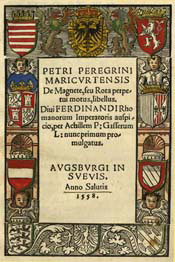
Pierre de Maricourt, an engineer in the French army besieging Lucera, completed a Latin letter to Sygerus of Foucaucourt on the lodestone. He described poles, attraction and repulsion, a pivoted compass, and an experimental method. The letter was not printed until 1558.
Before
Chinese south-pointing spoons and needles are earlier. European sailors were already using magnetic needles by the late twelfth and early thirteenth centuries. What had not survived in Latin is a systematic experimental account.
Why
He says he writes so that Sygerus may understand the stone. Behind the courtesy is a practical world: direction-finding, military engineering, and a thirteenth-century hunger to make hidden virtues visible by trial.
Who
A Picard master of military engineering, known from his own letter and from Roger Bacon’s praise of a 'dominus experimentorum.' He writes to a fellow soldier, Sygerus. Almost nothing else of his life is securely known. The name Peregrinus likely marks pilgrimage or crusading service, not a surname in the modern sense.
Petrus Peregrinus de Maricourt (Pierre de Maricourt) · Sygerus of Foucaucourt · Charles of Anjou · Roger Bacon (later witness to his reputation)
What
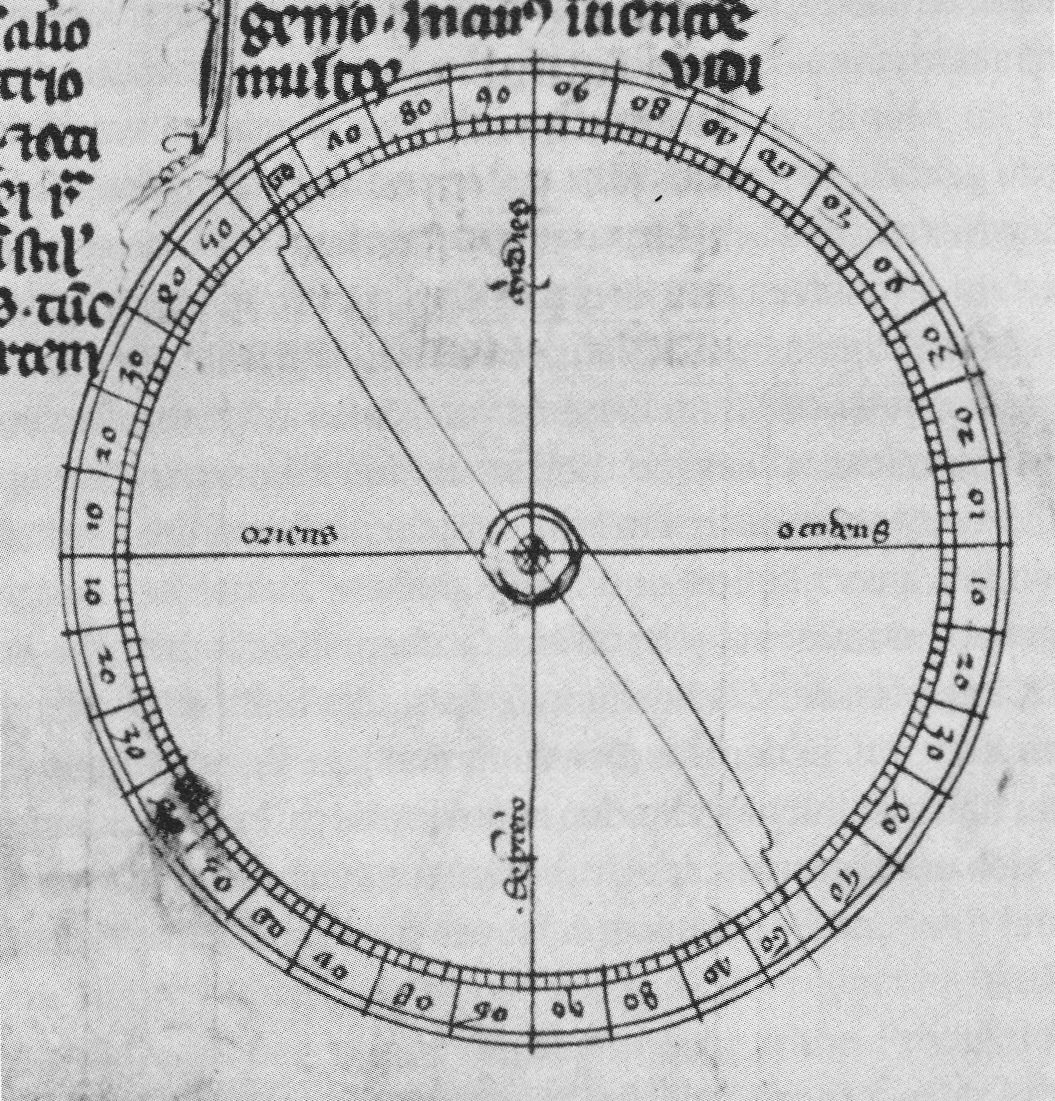
He wrote Epistola de magnete: how to find the poles of a lodestone, that like poles repel and unlike attract, how to make a magnetized needle turn on a pivot, and (more speculatively) a magnetic perpetual wheel. The lasting act is the experimental letter, not the wheel.
How
He tells the reader to shape the stone, mark it, float it, present iron to it, and build a dry pivoted instrument. The method is the point: do not only cite authorities, try the stone.
The hinge
The hinge is a dated letter from a camp, in which an invisible virtue is given poles, rules, and an instrument that can be rebuilt.
Where, and when
A military camp outside Lucera in Apulia. The writer is fortifying, mining, and building engines. The magnet work is done in that noise, not in a quiet study. The letter is dated 8 August 1269, from the siege. Lucera, a Muslim colony under Hohenstaufen then Angevin pressure, fell that same August.
8 August 1269 · The Angevin camp at Lucera, Apulia
What they knew
He knew lodestones, needles, and the practical compass. He used the word polus for the magnetic pole. He did not have a theory of Earth’s magnetic field.
What they could not know
William Gilbert’s De magnete (1600), terrestrial magnetism as a science, declination as a mapped quantity, or the later pairing of electricity and magnetism.
Source object
Epistola de magnete (manuscripts; first printed 1558)
A short Latin letter. Manuscripts survive. The first printed edition appeared at Augsburg in 1558, more than two centuries later.
The object survives.
First record
The letter itself is the first record. Roger Bacon, writing around the 1260s, praises an experimenter from Picardy who is widely taken to be this man, but Bacon does not date the magnet letter.
After
The letter circulated in manuscript. Early modern readers, including the 1558 editor, treated it as a founding text before Gilbert.
Later retelling
Popular history sometimes says Peregrinus 'invented the compass' in 1269. He did not. He described and improved an instrument already in use, and he wrote down an experimental grammar for the stone.
Limit
This does not prove that 1269 caused magnetism to be understood, or that years ending in 69 favor discovery. It proves that this letter is dated 1269.
What it does not prove
Does not make 69 a magnetic number, and does not assign Peregrinus the invention of the compass.
Why it entered
It entered the test because a primary source carries the year, the object, and a question about unseen direction. That is enough.
Question
How can something invisible give direction?
How we know
- 1. Petrus Peregrinus de Maricourt. Epistola de magnete. Letter dated 8 August 1269, Lucera. First printed Augsburg, 1558. English: The Letter of Petrus Peregrinus on the Magnet, A.D. 1269. Translated by Brother Arnold. New York: McGraw, 1904. See the record
- 2. Institution of Engineering and Technology. Archives biographies: Pierre de Maricourt, 'Peter Peregrinus.' See the record
- 3. Roger Bacon. Opus tertium. c. 1267. Contains praise of an experimenter from Picardy, commonly identified with Peregrinus.
Method
independent firsthard
The aperture
NAVIGATION, SCIENCE, ENGINEERING. Independent first. The date is on the letter: 8 August 1269.
Regions checked
- Europe
- Middle East (Mamluk, Maghrib)
- East Asia (Yuan)
- South Asia
- Africa
- the Americas
Included / excluded
- Included: Peregrinus letter
- Excluded: Invention of the compass. Earlier in China and already known to European sailors. A miss if claimed as 1269 origin.
- Excluded: Eighth Crusade. 1270. Neighbor year. Louis IX dies at Tunis in 1270.
68 | 69 | 70
Same century. Same research threshold. Matched frames. Neither pane brighter except that the middle year is the selected aperture.
1268
Neighbor
Mamluks take Antioch. The Lucera revolt and siege are already in motion. A heavy political year beside the letter.
1269
Aperture
NAVIGATION, SCIENCE, ENGINEERING. Independent first. The date is on the letter: 8 August 1269.
1270
Neighbor
Eighth Crusade. Death of Louis IX at Tunis. The crusade is not 1269.