Anchor year
1669
He was not looking for this.
Around 1669, Hennig Brand, a Hamburg merchant-alchemist, boiled huge quantities of urine in search of a way to riches. What condensed in his retort burned with a cold-looking light. Later chemistry would call the element phosphorus, the light-bearer. Brand was trying to make gold. He found a substance that would not yet have that name in his mouth as a modern element.
What if the thing you find is not the thing you were looking for?
Hamburg · c. 1669
He was not looking for this.
LIGHT
Light from the retort
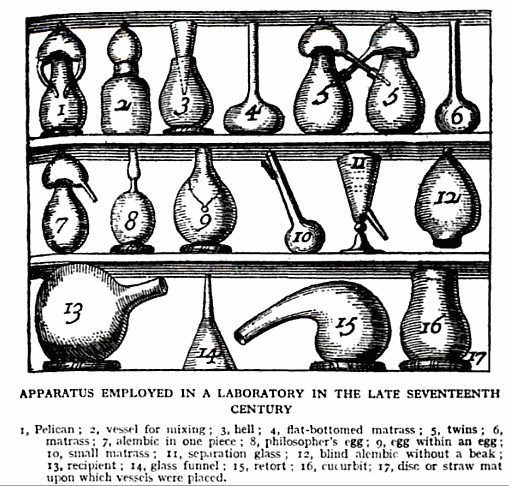
Brand isolated white phosphorus by distilling residues of urine. He tried to keep the process secret. The year 1669 is the date given in the later chemical tradition; no laboratory daybook of Brand’s survives with a calendar day. Naming and publication came through others.
Before
Alchemy already knew phosphorescent materials and 'cold lights' of other kinds. No one in Europe had isolated this element. Boyle and others were already changing what counted as a chemical public.
Why
He was hunting the philosopher’s stone or a related chrysopoetic secret: a way to noble metal. Urine was a reasoned material in that craft, not a random joke.
Who
Hennig Brand, about whom little is certain: a German who had been a merchant and a soldier, working in Hamburg, married into enough money to fund an expensive furnace. He was an alchemist, which in 1669 was not a joke-title. It was a craft of matter, medicine, and hope.
Hennig Brand · Johann Daniel Kraft (later purchaser of the secret) · Johann Kunckel · Robert Boyle (later independent investigator)
What
He evaporated urine, heated the remaining paste fiercely, and obtained a waxy substance that shone in the dark and took fire. That substance is elemental white phosphorus.
How
Concentration, high heat, condensation of a fraction that glowed. He then hid the method, as a secret of value, and later sold knowledge of it.
The hinge
The hinge is a glow in a darkened workroom, produced from a residue, by a man who wanted something else.
Where, and when
A Hamburg workshop and furnace. The smell, the cost of fuel, and the quantity of urine are part of the documented later retellings. Sensory extras beyond the sources are not added here. The received date is 1669. It is a year-date in later histories, not an observed day. Treat it as conventional and still the year this project must test.
c. 1669 · Hamburg
What they knew
Brand knew how to run a furnace and how to keep a secret. He could see that the substance was new in practice. He did not have a table of elements.
What they could not know
That this would be counted as the first isolation of a chemical element in the modern sense. Matches, nerve agents, fertilizers, or the later moral of 'accident.' He also could not know Joseph Wright’s 1771 painting of an alchemist with phosphorus, which is a later image, not a portrait of Brand at work.
Source object
No Brand laboratory notebook; later chemical reports and Wright’s 1771 painting (not a primary 1669 image)
The discovery is known from later witnesses and from the substance’s public life. Absence of Brand’s own dated page is part of the source problem.
The object does not survive as a single thing.
First record
Second-hand. Kraft demonstrated the substance. Kunckel and Boyle published related work in the 1670s and 1680s. Brand’s 1669 is a reconstructed year.
After
The secret leaked and was sold. Phosphorus became a European chemical curiosity, then an industry.
Later retelling
School stories laugh at urine and call Brand a bungler who tripped over an element. That laugh uses later chemistry as a punch line. In his terms he was doing the work. The finding was unexpected. The labor was not a pratfall.
Limit
The year is softer than Peregrinus’s 8 August or Watt’s patent day. A conventional year can still be the right window to test, if the uncertainty is shown.
What it does not prove
Does not prove 1669 as a calendar day, and does not ridicule alchemy from a later hill.
Why it entered
It entered the test as a dated (if conventional) isolation of matter that announces itself as light. The question is about finding, not about 69 as fate.
Question
What if the thing you find is not the thing you were looking for?
How we know
- 1. Eknoyan, Garabed. 'Phosphorus: Chronicles of the epistemology of a vital element.' 2024. Places Brand’s isolation in 1669 as a reconstructed year in later chemical tradition. See the record
- 2. Eknoyan, Garabed. 'Phosphorus: Chronicles of the epistemology of a vital element.' Kidney International Reports, 2024.
Method
independent firsthardcontested
The aperture
MATTER, LIGHT, SCIENCE. Independent first. The year is conventional, not a day-date.
Regions checked
- Europe
- East Asia (Edo Japan)
- the Americas
- South Asia (Mughal)
- Africa
- Middle East (Ottoman)
Included / excluded
- Included: Phosphorus isolation
- Excluded: Newton’s optical discoveries as a 1669 publication. Work of the mid-1660s; the famous paper is 1672. A miss if claimed as 1669.
- Excluded: St. Helena, 'first' of anything here. Not forced.
68 | 69 | 70
Same century. Same research threshold. Matched frames. Neither pane brighter except that the middle year is the selected aperture.
1668
Neighbor
Newton’s reflecting telescope is often dated around 1668. Treaty of Lisbon recognizes Portuguese independence. A neighbor with an instrument.
1669
Aperture
MATTER, LIGHT, SCIENCE. Independent first. The year is conventional, not a day-date.
1670
Neighbor
Hudson’s Bay Company charter 1670. English colonial neighbor.