Anchor year
1769
Sky, and engine.
On 3 June 1769, from a point on Tahiti later called Point Venus, James Cook, Charles Green, and their companions timed the planet Venus as it crossed the Sun. On 5 January of the same year, in Britain, James Watt was granted patent number 913 for a new method of lessening the consumption of steam and fuel in fire-engines. The two events did not cause one another. They share a year. That is enough.
How can a small observation help measure an enormous system?
Same year. No arrow.
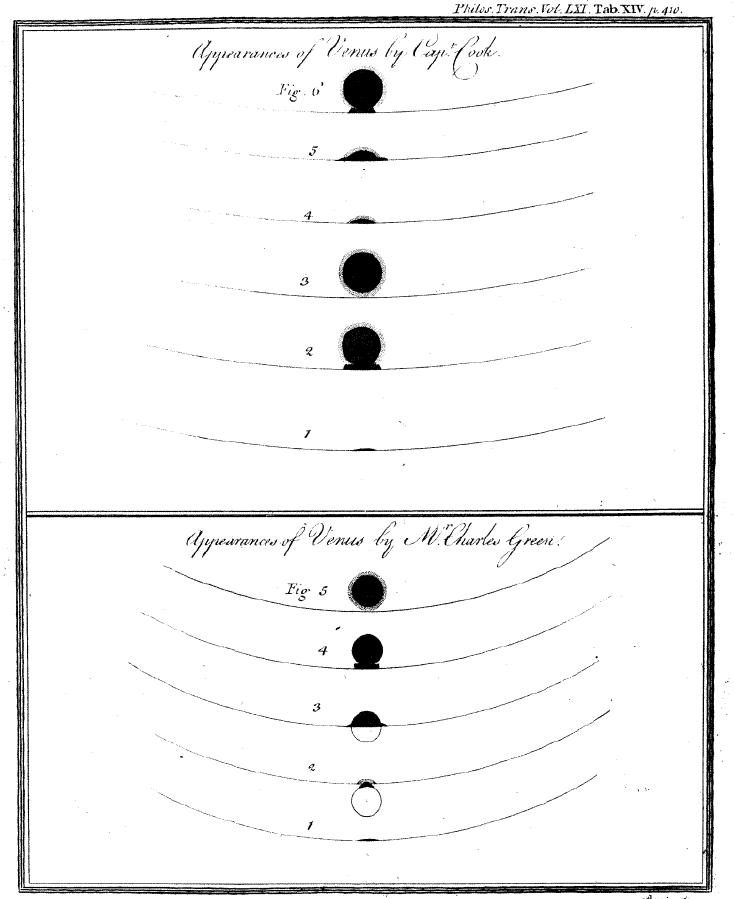
Sky
Venus across the Sun
On 3 June 1769, from Tahiti, James Cook and Charles Green timed a planet as it crossed the Sun, one node in a worldwide attempt to measure the scale of the solar system. HMS Endeavour had left Plymouth in 1768.
Same year
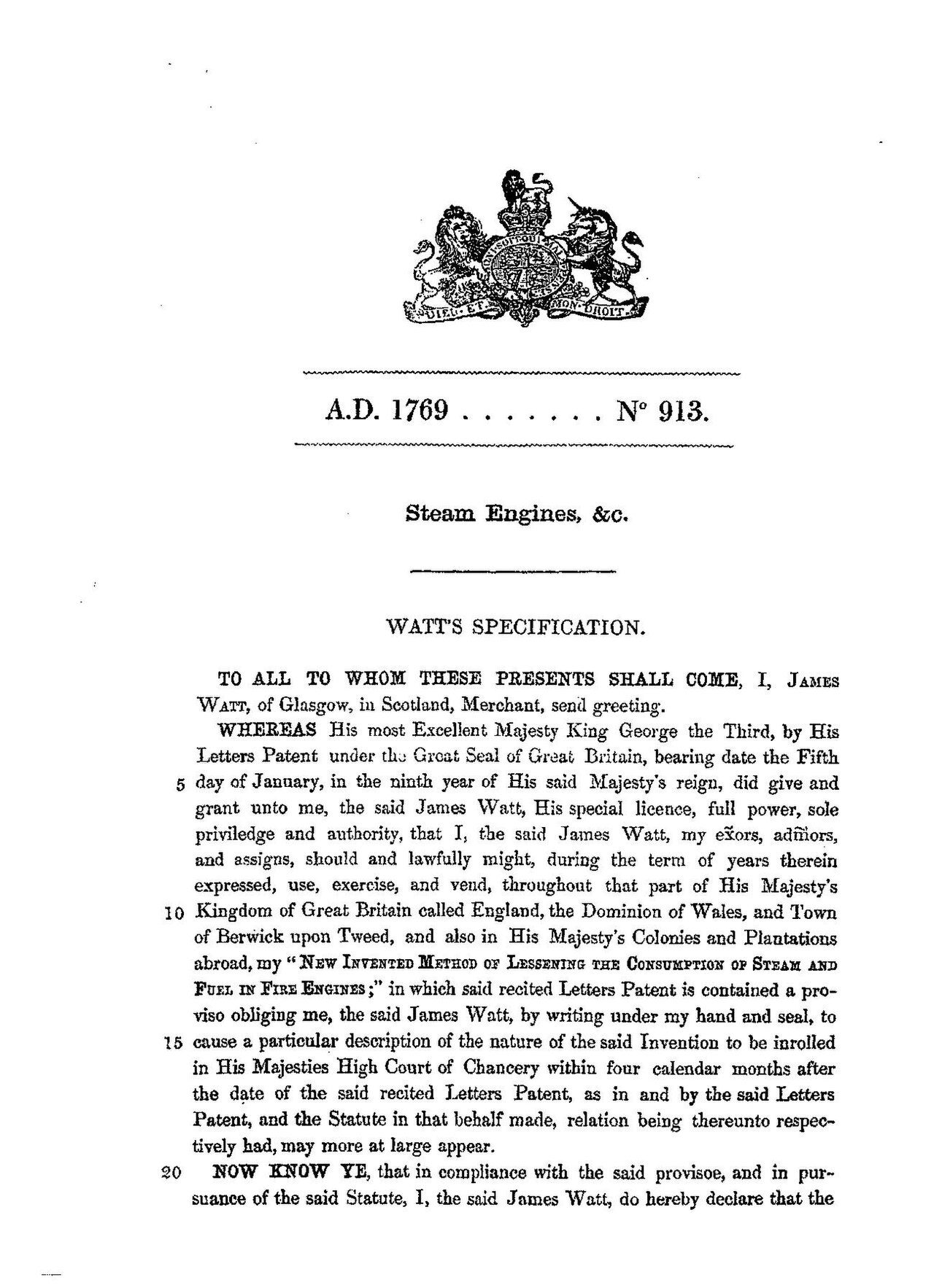
Engine
A separate condenser
On 5 January 1769, in Britain, James Watt was granted patent 913 for lessening the consumption of steam in fire-engines already so called. He did not invent steam. Newcomen’s engine was already pumping mines.
Two shores, matched frames. Period sources, not modern reconstructions. They share a year. They do not cause one another.
SKY
Venus across the Sun
The 1769 transit of Venus was a planned worldwide measurement. If observers at distant latitudes timed the contacts, astronomers hoped to find the solar parallax and, from it, the scale of the solar system. Cook commanded HMS Endeavour for the Royal Navy and the Royal Society. Charles Green was the expedition astronomer. The Tahiti times were one node, not the whole.
Before
1761’s mixed results. A European race for the solar scale. Polynesian navigation already knew the Pacific without this particular number.
Why
Halley had shown that transits of Venus could yield the astronomical unit if timed from far-apart places. 1761 had been clouded and politically hampered. 1769 was the second chance in a lifetime.
Who
Cook, a Royal Navy lieutenant who had already surveyed the St. Lawrence and Newfoundland; Green, formerly of Greenwich; Banks and a natural-history party; Tahitian hosts of the island of Ra'iatea and Tahiti, whose names the English records often flatten; and observers at other stations, including Jean-Baptiste Chappe d'Auteroche in Baja California, who died after the transit.
James Cook · Charles Green · Joseph Banks · Tupaia (later on the voyage) · the Royal Society · observers in California, Hudson Bay, India, Europe, and elsewhere
What
They built an observatory at Point Venus, tracked the planet’s entry and exit on the solar disk, and wrote numbers. The same voyage later carried secret Admiralty instructions to search the south for a continent.
How
Telescopes, clocks, a portable observatory, and a method that still suffered from the black-drop effect: the planet seemed to cling to the Sun’s limb, smearing contact times.
The hinge
The hinge is a timed contact: a black bead on a bright disk, written down by more than one hand at more than one station.
Where, and when
A sandy point on Tahiti’s north shore, chosen for clear sky and longitude. The work happened in a borrowed geography, under a Polynesian political world the English did not command. Transit day was 3 June 1769. The Endeavour had left Plymouth in August 1768. The observation is 1769. The departure is a neighbor.
3 June 1769 · Matavai Bay, Tahiti; and a global net of other stations
What they knew
They knew they were measuring a time to serve a geometry. They knew the weather could ruin it. They did not yet have a settled astronomical unit.
What they could not know
How large the remaining error would be, how later photography and radar would redo the scale, or what the rest of the Endeavour voyage would do to Māori, Australian, and Polynesian histories.
Source object
Cook’s and Green’s journals; Royal Society reports
Manuscript logs and later printed voyages. The numbers are the object, not a romantic sunset.
The object survives.
First record
Ship journals and observatory notes of 1769, then official voyage publication.
After
The solar parallax improved and remained disputed. Cook sailed west and south. Green died of dysentery at Batavia on the way home.
Later retelling
The story often becomes Cook alone, discovering. Green disappears. Tahiti becomes scenery. The transit was a network, and the island was a place with its own names.
Limit
A good measurement in a hard year is not a complete solar system. Other stations, some tragic, belong to the same attempt.
What it does not prove
Does not make Cook the only observer, and does not connect the transit to Watt.
Why it entered
It entered the test because a dated observation tried to measure what could not be walked: the size of the system that holds us.
Question
How can a small observation help measure an enormous system?
How we know
- 1. James Cook. Journal of HMS Endeavour, 1768–1771. Transit observations at Tahiti, 3 June 1769.
- 2. Charles Green. Astronomical observations on the Endeavour voyage, 1769. Green died at Batavia on the return.
- 3. Edmond Halley. Proposal for using transits of Venus to determine solar parallax. Philosophical Transactions, 1716 (method earlier than the 1761 and 1769 campaigns).
Method
independent firsthard
ENGINE
A separate condenser
British patent 913, 5 January 1769, covered Watt’s method of condensing steam in a vessel separate from the working cylinder, so the cylinder could stay hot. Newcomen engines had cooled the cylinder with every stroke. Watt’s idea dates to 1765. The patent is 1769. A marketable engine with Boulton is later still.
Before
Newcomen (1712) had already made a useful mine pump. Watt did not invent the steam engine. He changed its thermal economy.
Why
Newcomen’s atmospheric engine wasted heat by spraying cold water into the cylinder. Watt wanted more work from less coal.
Who
James Watt, instrument-maker to the University of Glasgow, then in partnership troubles with John Roebuck of Kinneil. Matthew Boulton is not yet the partner of the Soho years.
James Watt · John Roebuck · later Matthew Boulton
What
A legal instrument: 'A new method of lessening the consumption of steam and fuel in fire-engines.' The physical idea is a separate condenser.
How
Keep the cylinder hot. Condense the steam somewhere else. Later, further improvements (sun-and-planet gear, double action) are not 1769.
The hinge
The hinge for this aperture is the 1769 grant, a piece of paper that protects a thermodynamic idea. The hinge of the idea itself is 1765, which this project will not steal.
Where, and when
The patent is British. The insight is tied to Glasgow Green and to a model Newcomen engine Watt had been asked to repair. Patent 5 January 1769. Conception 1765. Commercial success after 1775, when the patent was extended.
5 January 1769 · Great Britain (patent); the idea formed earlier at Glasgow
What they knew
He knew the waste was in cooling. He knew a patent was a weapon as well as a description.
What they could not know
Railways, steamships, factory time, or the later political name Industrial Revolution. He also could not know how tightly his patent would be fought.
Source object
British patent 913
A legal text, not a working engine on the day of issue.
The object survives.
First record
The patent roll and Watt’s correspondence.
After
Roebuck failed. Boulton took over. Engines spread on a delay measured in years.
Later retelling
School posters say Watt invented the steam engine in 1769. He did not. He patented a condenser. The poster is the miss.
Limit
A patent year is not an industrialization year. 1769 does not contain the factory.
What it does not prove
Does not invent the steam engine, and does not couple Watt to Venus.
Why it entered
It entered the test as a dated engineering act in the same year as the transit, without being asked to explain the sky.
Question
What happens when observation and engineering move forward in the same year?
How we know
- 1. James Watt. British patent 913, 5 January 1769. 'A new method of lessening the consumption of steam and fuel in fire-engines.'
- 2. Russell, Ben. 'James Watt and the separate condenser.' Science Museum blog, 5 January 2019. See the record
Method
independent firsthard
The aperture
SKY and ENGINEERING in the same window. Independent first, twice. Do not braid them into one machine.
Regions checked
- Oceania
- Europe
- the Americas
- South Asia
- East Asia (Qing)
- Africa
Included / excluded
- Included: Transit; Watt patent
- Excluded: Napoleon’s birth as a pattern hit. Incidental. A famous birth is not a reason unless the project is doing celebrity numerology, which it is not.
- Excluded: Endeavour’s departure. August 1768. Neighbor.
68 | 69 | 70
Same century. Same research threshold. Matched frames. Neither pane brighter except that the middle year is the selected aperture.
1768
Neighbor
Endeavour sails from Plymouth, 26 August 1768. The transit story begins in the neighbor year. Watt is already years past the 1765 insight.
1769
Aperture
SKY and ENGINEERING in the same window. Independent first, twice. Do not braid them into one machine.
1770
Neighbor
Cook on the east coast of Australia. Watt still not in commercial production. Beethoven born, incidental.