1690 is a year that contains the digits 69. It is not a year ending in 69. The reader should never wonder whether it qualifies. It does not.
The book that earned its place
An Essay Concerning Humane Understanding
John Locke
“Consciousness always accompanies thinking, and it is that that makes every one to be what he calls self.”
Axial coding of the Essay
How the mind comes by its ideas. Not a stock of innate principles. Not a proof about years ending in 69.
Sensation
From without
The senses furnish ideas. Colour, solidity, sound: what the world writes on the mind.
Reflection
From within
The mind’s own operations become objects of thought. Perception, willing, remembering: what the mind notices itself doing.
Identity
Continuity
Personal identity, for Locke, is consciousness continuing through time. The person is the thread, not a hidden substance.
Accountability
Follows
Moral accountability rides that continuity. A person can be answerable because the same consciousness can own the act.
Four codes, one book. John Locke, 1632 to 1704, English physician and philosopher. He was already in a separate inquiry into consciousness before any number was asked of his name. Context first. Then the wink.
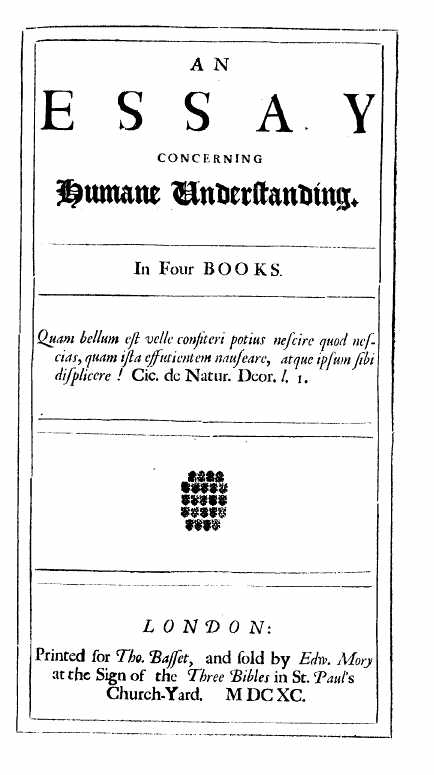
Title page of the first edition. The printed title is An Essay Concerning Humane Understanding, in four books. The year on the page is 1690. Publication began in late 1689; the title page is dated 1690. That bibliographic fact is ordinary, and it is why this page exists at all. Wikimedia Commons. Public domain. John Locke, 1690.
Context first. The book is a theory of understanding. It is not a proof about years ending in 69. It is not evidence that 69 means anything in history.
Then the wink, and only then: the digits 69 sit inside 1690. A later cipher check of the name JOHN LOCKE, by reverse reduction, totals 42. That check is shown below as arithmetic, letter over number, because it is how a question was noticed. It is not how a century is explained.
The hinge
JOHN LOCKE
Reverse Reduction
J8O3H1N4L6O3C6K7E4
J8O3H1N4 · L6O3C6K7E4
42
J 8 · O 3 · H 1 · N 4. Sixteen. L 6 · O 3 · C 6 · K 7 · E 4. Twenty-six. Sixteen and twenty-six are forty-two.
Subject first: consciousness, personal identity, moral accountability. Then the name was counted. Reverse reduction totals 42. That 42 did not close the inquiry. It opened a question about 69.
1690
Then the wink. 690 sits inside 1690 once the thousands are set down. The year still does not qualify. The wink is allowed.
How the question arrived
Subject first
Locke was already in the room because of consciousness, personal identity, and moral accountability.
History first
The first edition of the Essay is dated 1690.
Correspondence noticed
The 69 inside 1690 was visible. A name-cipher, already in use elsewhere, was then checked. It is not why Locke was read.
Question asked
What else happened in the 69 years?
Pattern test begun
Attractive examples were not enough. Every century year from 69 CE through 1969 was opened. Misses were kept. Neighbors were compared.
Curiosity started the search. Method keeps it honest.
The other contained form currently admitted is 420 CE, which contains 42. Same numerical class. Different history. For the rest of the lattice, open the cipher. 1669 and 1769 sit on either side of 1690 on the calendar. They do not sit on either side of it on the spine.